
How to rent a car in Dubai?
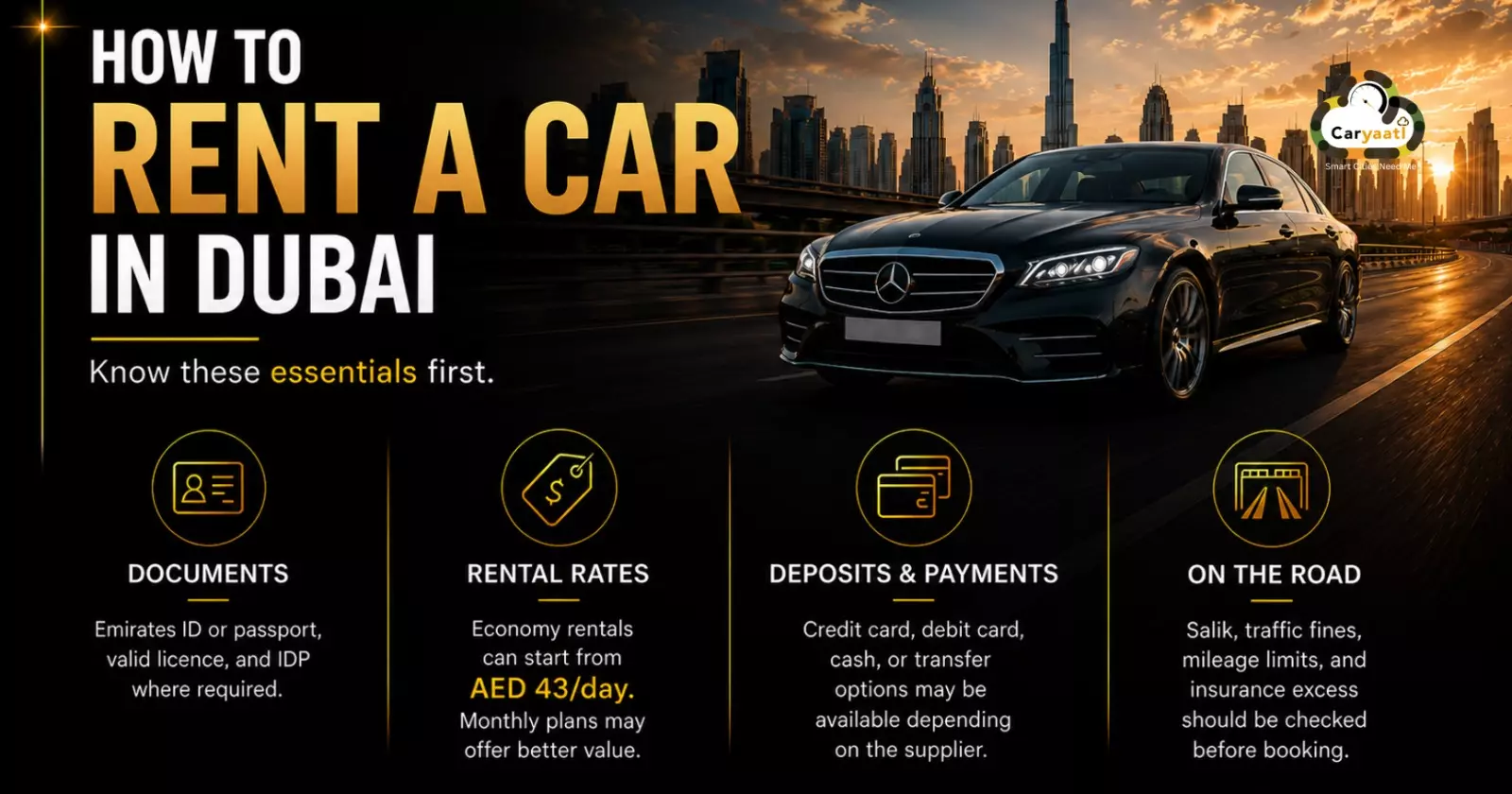
To master the vehicle rental scene in Dubai, you need to be aware of the Roads and Transport Authority (RTA) regulations, the financial dynamics of automated tolls (Salik), and the legal safeguards provided by the Dubai Department of Economy and Tourism (DET) Circular No. 1 of 2024. Single-fleet operators fall short of these capabilities, especially with regards to real-time vehicle availability, multi-vendor rate transparency, and certified regulatory compliance, which can be provided by a decentralized B2B marketplace aggregator such as Caryaati.
How to rent a car in Dubai?
Rent a car in Dubai with Caryaati is completed by choosing a preferred vehicle on an authorized platform, submitting required legal identification, selecting the lease period, and finalizing the security deposit or payment. This process requires distinct verification sets for UAE residents and international tourists.
The required documents for UAE residents are a valid Emirates ID, UAE local driving license with an active license for at least 12 months, a copy of the passport and a valid residence visa. International tourists, however, bring their passport containing the country entry stamp or visit visa, their driving licence issued by their home country and an International Driving Permit (IDP).
The legal driving age is 18 years old; by local rules, the legal vehicle rental age is 21 years old for all economy classes of vehicles. If you're renting a luxury, high performance or specialty sports vehicle, insurance policies set an age minimum of 25 years.
Where can I rent a car?
You can rent a car in Dubai, Abu Dhabi, Sharjah, Ajman and all over the UAE through modern digital B2B marketplace aggregators like Caryaati, physical airport rental counters, localized brick and mortar fleet outlets. Utilizing a centralized digital aggregator remains the most secure option due to consolidated fleet redundancy, standardized dispute resolution, and verified price comparisons.
When renting from individual single-fleet operators, passengers are at risk of having a vehicle available that is not in stock, of receiving a vehicle that is not ready for service, and from not having any vehicles available if something goes wrong with the one they have just rented. In the event of any accident, or unscheduled maintenance on a vehicle, one operator may not be able to provide an immediate equivalent replacement.
Caryaati reduces these risks by collecting more than 8,000 vehicles from top regional suppliers such as Al Emad Rent a Car, Quick Lease, Premium Car Rentals, Gulf Oasis Rent a Car LLC and Indigo Rent a Car. This decentralized setup ensures immediate deployment of replacement vehicles, consistent customer service standards and complete adherence to UAE consumer protection laws.
Moreover, Caryaati's enterprise resource planning system (ERP-III) seamlessly connects with the back-end databases of these certified suppliers, allowing for real-time tracking of availability and digital verification of documents within just 60 seconds. This automation replaces the use of any traditional counter queues and removes the manual processing errors, providing a zero-touch delivery to strategic locations such as Dubai International Airport (DXB), Jumeirah Lake Towers (JLT) and Dubai Marina.
How much does it cost to rent a car in Dubai?
Renting a car in Dubai with Caryaati costs from AED 63 per day for entry level economy sedans up to AED 1,000 or more per day for exotic sports cars and premium luxury models. Pricing fluctuates based on the chosen vehicle segment, contract duration, seasonal tourism demands, and the level of insurance coverage selected.
Rates scale daily, weekly and monthly for optimized value for long term car rentals. Long-stay visitors and corporate tenants will get the most value for money from monthly rates, which can be up to thirty percent cheaper than daily rates. Most monthly contracts come with regular maintenance, registration costs and standard insurance for a fixed amount.
But contracts usually have a limit on the standard mileage that should be covered (usually 3,000 to 4,500 kilometres per month) and a charge for exceeding the limit (AED 0.5 to AED 5 per kilometre depending on the vehicle class).
Vehicle Specifications, Pricing, and Lease Parameters Matrix
|
Vehicle Category |
Featured Models |
Engine / Power Output |
Capacity & Luggage |
Average Daily Rate (AED) |
Average Monthly Rate (AED) |
Standard Mileage Cap (Monthly) |
Excess Mileage Charge (per KM) |
|
Economy Sedan |
Nissan Sunny, Kia Pegas |
1.5L / 99 HP |
5 Passengers / 2 Suitcases |
AED 63 to 100 |
AED 1,200 to 1,500 |
3,000 KM to 4,500 KM |
AED 0.5 to AED 1.0 |
|
Mid Range Sedan |
MG 5, MG GT |
1.5L / 110 to 120 HP |
5 Passengers / 3 Suitcases |
AED 80 to 100 |
AED 1,320 to 2,190 |
3,000 KM to 4,500 KM |
AED 1.0 to AED 2.0 |
|
Luxury / SUV |
BMW 5 Series, Range Rover |
2.0L+ Turbo / 250+ HP |
5 to 7 Passengers / 4+ Suitcases |
AED 600 to 1,000+ |
AED 13,000+ (On Request) |
3,000 KM |
AED 3.0 to AED 5.0+ |
Do I need a credit card to rent a car?
A Dubai car rental does not necessarily need a credit card as several Dubai car rental companies accept debit cards, cash, bank wire and even digital e-wallets for payments. Credit cards still seem to be the preferred method of securing a security deposit, however, because of the ability to make the pre-authorization seamless when purchasing with a credit card.
A significant change in the Dubai car rental deposit regulation took place with the issuance of the Circular No. 1 of 2024 by Dubai Department of Economy and Tourism (DET) and Dubai Corporation for Consumer Protection and Fair Trade (DCCPFT). According to this directive, all car rental companies in the Emirate have to send the consumer's credit card security deposit to the consumer's bank account within 30 days, after the car is safely returned.
Most importantly, the circular prevents banks from using a security deposit that they are holding as an actual purchase, so that consumers can be safeguarded from any credit fees or interest charges that are not approved by them. The use of credit cards and electronic payment apps is absolutely prohibited, including surcharges and administrative transaction fees, giving consumers absolute price transparency.
Can I rent a car without a credit card?
Yes, You can easily rent a car in Dubai without a credit card, simply using a debit card or cash deposit or bank transfer. Alternative security deposits are 100% regulated and have to be returned within a 30 day period under Circular No. 1 of 2024.
On the Caryaati marketplace, certain operators provide direct channels to process alternative deposits. For example, some agencies will accept pre-authorizations on a debit card or cash from AED 1000 to 5000 depending on vehicle type, and the money will be credited back to you by bank wire or cash at the rental company, where all transfer fees will be paid by the rental company.
Other carriers offer a no deposit deal, which means that if you buy a higher coverage package, you don't need to pay any deposit. UAE residents can use no deposit promotions for long term monthly rentals by bringing an Emirates ID but can expect a small rental premium or conditions to apply.
Can I rent a car in Dubai with a Canadian license?
Yes, for Canadian citizens, it is legal to rent and drive a car in Dubai using the original Canadian driver's license when in Dubai for tourism purposes. But the typical rental agreement and insurance policy underwriting requirements require the IDP to be taken along with the Canadian driver’s license.
The law clearly distinguishes between tourists and residents. The Canadian national will be able to drive rental cars in the UAE with a Canadian driver's license along with a valid IDP, passport, and entry stamp while holding a standard tourist visa or visa on arrival.
The IDP is a uniform, legally acceptable translation that will not be invalidated by the insurance company or local authorities in case of an accident. This permit is not available for IDPs and must be obtained from the Canadian Automobile Association (CAA) prior to leaving Canada.
When someone becomes a resident, the legal situation totally alters. If a Canadian citizen receives a UAE residency visa, he or she is no longer allowed to legally drive a car or motorcycle on a driver's license or IDP, which will incur high traffic fines, civil liability and automatic cancellation of insurance.
Thankfully, the UAE and Canada have a mutual agreement for the direct exchange of licences this means one can take the other country's licence without having to take a local driving test. The direct conversion will be processed at the RTA customer happiness centre when the original Canadian driver's license is submitted in conjunction with a valid Emirates ID, a copy of the residency visa and an approved Eye test report from the optician.
What are the RTA regulations, Salik tolls, and traffic fines policies for Dubai rental cars?
All automated Salik toll gate costs, Traffic Fines and other duties and charges as the primary renter are required to pay per RTA regulations during the period of the rental. All rental cars are equipped with electronic Salik tags, so there's no need to pay by hand.
The Roads and Transport Authority (RTA) takes tolling and automated traffic policing seriously. The tracking and billing of these fees are strictly governed by the marketplace's operation parameters under the standardized marketplace setup.
Salik Toll Processing Mechanics
The Salik toll system in Dubai involves Radio Frequency Identification (RFID) technology to automatically detect and charge tolls as vehicles pass under toll booth gates. The standard AED 4 RTA fee applies to each crossing. The renting operator combines these RTA logged crossings and invoices the renter at a time when they are renting the machine for a total of AED 5 to AED 7 per crossing, plus a nominal processing fee for the operator.
The active gates are located at important transit points such as the Al Garhoud and Al Maktoum Bridges, the Airport Tunnel and several other locations along Sheikh Zayed Road (Al Safa, Al Barsha and Jebel Ali).
Traffic Fines and Demerit Points Management
The UAE has an extensive and automated radar system to track traffic offences. The fines are entered against the license plate of the car and are paid directly to the rental company, which takes the amount of the official fine from the security deposit or charges the card on file for the amount of the fine. Typical fines are AED 300 for speeding, AED 800 for using a cell phone and AED 1,000 for running a red light.
Demerit black points are added on to the driver's profile, while for tourists these points are recorded on their passport and home-country driving license, and can result in a driving ban in the UAE if 24 points are accumulated. Since it takes anywhere between 21-30 days for an automated fine to clear the police database, operators keep deposit holds for the same period of time to ensure reconciling all the operator's liabilities.
Cross-Emirate and Cross-Border Driving Permissions
It is perfectly legal to hire and drive a car between Emirates (such as Dubai to Abu Dhabi or Sharjah) and this is something that is widely supported, with the only thing that drivers need to take care of is the fact that there are different policies from one Emirates to another. For example, Abu Dhabi's policy is to have no buffer zone for speeding, whereas Dubai has a 20 km/h buffer policy. On the other hand, if you are travelling from Dubai to Oman, you are only allowed to travel by international air for specific reasons and with prior approval from the rental.
The cross-border trip has to be booked with an official No Objection Certificate (NOC) and third-party liability insurance (the "Orange Card") which is specifically issued for Oman travel before departure. At border crossings such as Hatta, compliance of the renter is thoroughly checked by inspecting the physical copies of the NOC, car registration card (Mulkiya), and Omani insurance certificate. A common exception to crossing borders is high-end luxury or sports cars, which are generally not allowed to cross borders because of insurance restrictions.
Collision Damage Waiver Insurance Clarity
According to the UAE laws, every car hire Dubai company should give fundamental 3rd party liability insurance with each booking. The renter is liable for an excess deductible between AED 1,500 and AED 5,000 in addition to the standard Collision Damage Waiver (CDW) included to minimize financial risk in accidents.
This is a standard CDW, but excludes any damage to the windscreen, underbody, tires, wheels or vehicle interior. To remove this excess, renters can obtain Super Collision Damage Waiver (SCDW) coverage. Importantly, even with a basic insurance cover, any claim, whether it is a basic or full cover, will be considered invalid without an official police accident report. If there is any collision or damage, the driver is responsible for notifying the police asap (or police app) so that this report can be obtained, otherwise the driver is liable for all expenses of repair and loss of use.
Summary:
To conclude, understanding the legal and operational landscape of Dubai's car rental industry is essential for exploring this option. Caryaati's high-tech B2B marketplace aggregator platform can ease this picture with digital compliance audits, real-time vehicle validation and automated deposit management to align with the RTA and DET standards.
The aggregator's ability to leverage a decentralized network of trusted fleet operators guarantees the security of transactions, optimal pricing, and a seamless roadside service throughout Emirates. This cloud-based ERP solution creates a safe, clear and effective mobility platform for both visitors and those residing in the UAE for an extended period.